Daniel Kahneman spent fifty years finding the ways a mind gets things wrong, and won a Nobel Prize for it. In the introduction to Thinking, Fast and Slow he reports the result of all that study on himself: his own intuitive thinking was as prone to overconfidence, extreme predictions and the planning fallacy as it had been before he started.
He had the evidence. Years earlier he had led a team writing a textbook on judgment for Israeli schools. Asked how long it would take, every member of the team, Kahneman included, said between a year and a half and two and a half years. It took eight. By then the ministry had lost interest, and the textbook was never used. The man who named the planning fallacy fell into it while writing a book about it.
That is the whole of this essay. You have a brain. So you are biased, in the same ways everyone else is, and the ways do not go away when you learn their names.
Nobody is exempt#
It would be comforting if bias were a beginner's problem, trained out by experience. The record says otherwise.
Kahneman was once asked to speak to the advisers of a firm that managed money for very wealthy clients, and he asked for data first. He was given eight years of results for twenty-five anonymous advisers. He computed the correlation between each adviser's ranking in one year and the next, twenty-eight pairs of years in all. The average was 0.01. The firm paid bonuses on those yearly rankings, and the directors, told that they were rewarding luck as if it were skill, went on doing it.
Brad Barber and Terrance Odean studied 66,465 households at a discount broker from 1991 to 1996. The fifth that traded most earned 11.4% a year. The market returned 17.9%. In a separate study of 10,000 accounts, Odean found a strong preference for selling winners over losers, and the subsequent performance of the stocks did not justify it. These were ordinary people with real money, doing the thing a brain does with a position: cut what feels good to cut, keep what hurts to sell, and trade more when confident.
The advisers were professionals. The households were adults with capital. Kahneman was Kahneman. The fault is in the equipment, and everyone has the same equipment.
The equipment#
Kahneman's picture of the mind has two systems. System 1 is fast, automatic and always on. It recognizes a face, finishes a sentence, and turns three red candles into a story about what happens next, before you have asked it to. System 2 is slow, deliberate and lazy. It can check the story, and mostly it does not, because checking is work and the story arrived first and felt true.
Every bias on Kahneman's list is System 1 doing its job on the wrong input. It was built to decide quickly from partial information, and a price chart is partial information that looks complete. A loss hurts about twice as much as the same gain pleases, so you hold the loser. The last three trades are vivid, so they stand for the system. The entry price is a number you know, so the position is judged against it. After the move, the setup looks obvious, because the brain has already rewritten what it knew before.
None of this feels like bias from the inside. It feels like seeing. That is why awareness is a weak defense: the bias has finished its work before awareness arrives, and awareness is itself a System 2 act that the brain skips when tired, pressed or losing.
Where each one gets a vote#
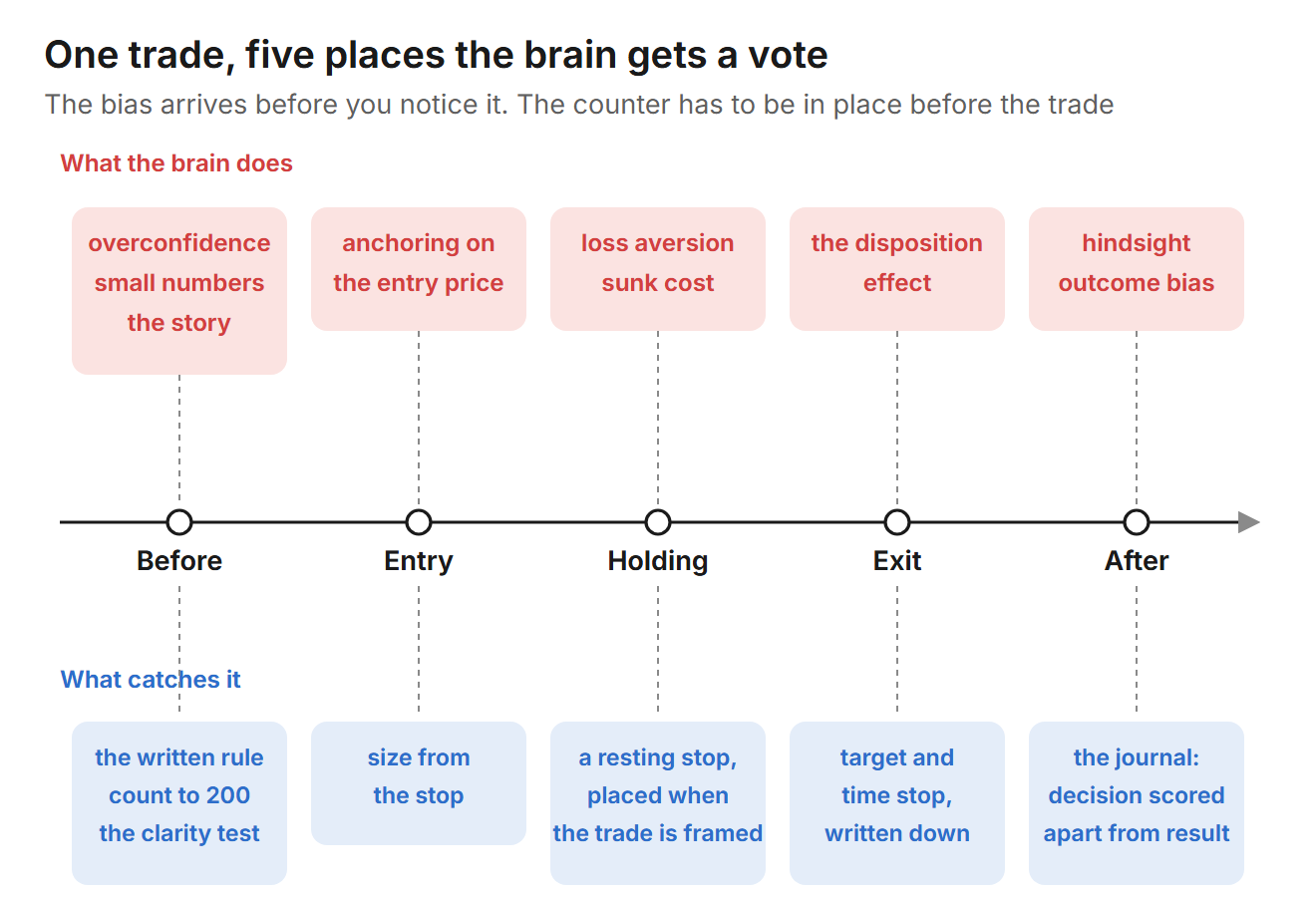
A single trade gives the brain five chances, and each has a name.
The bias arrives before you notice it; the counter has to be in place before the trade
Before the trade. Overconfidence, which Barber and Odean found in the most active fifth. The law of small numbers: five winners in a row reads as proof, when Market, System, Self showed a real edge needs about 200 trades to clear noise. And the story: the brain assembles breakout, earnings and a theme into a thesis, and the thesis feels like evidence.
At entry. Anchoring. The entry price becomes the number every later judgment is measured from, which is why "I'll get out at breakeven" is a plan so many traders have and no system contains.
While holding. Loss aversion and sunk cost together. The stop is reached and moved. The loss is "already taken," so adding to it costs nothing. Leverage Works Both Ways has the account that kept borrowing into the rally.
At exit. The disposition effect, Hersh Shefrin and Meir Statman's name for Odean's finding: winners sold early because the gain is pleasant to bank, losers held because the loss is painful to make real. It is the exact inverse of the rule every trader can recite.
After the trade. Hindsight: the five NVDA windows in Every Investor Is a Trader look obvious on the chart, and were invisible on the day. And outcome bias, grading the decision by the result, which Ronald Howard warned against in Which Market? and Jonathan Baron and John Hershey measured in 1988: raters judged the same decision better when it happened to turn out well.
Counters that do not need you#
Since the bias runs before you notice, the counters that work are the ones that were set before the trade and do not ask the brain's permission during it. Every one of them has appeared in this series, and this is why.
- The written rule. A setup defined so that two traders agree it happened, and the clairvoyant could confirm it. The story cannot be a reason, because the rule has no field for a story.
- Size from the stop. Dollars at risk divided by the distance to the price where the trade is wrong, worked out before entry, as in The Keel. Anchoring has nothing to grip, because the entry price plays no part in the arithmetic.
- The stop as an order, placed when the trade is framed. Loss aversion cannot move a stop that is already at the broker. A stop that lives in your head is a stop that negotiates.
- The count to 200. A rule that no judgment of the system is made before the sample is in. Small numbers lose their vote.
- The future hidden. Practicing on past sessions bar by bar, the next bar unseen until you have decided, with the call logged before the reveal. Hindsight cannot rewrite a decision that was written down first.
- The journal with timestamps, scored in R, with the decision graded against the rule and the outcome recorded separately. Outcome bias needs the two to be one number; the journal keeps them apart.
- The drawdown line, 20% from the peak, chosen at the dock. Overconfidence cannot raise a limit it did not set.
Dr. Ken Long's Zero State belongs here too, as a reset and never as a cure: a process for returning to balance before and during each trade, and a rule to exit when it is lost. It accepts that the operator will drift. The structures above are what hold while the operator finds the way back.
Edge S2 was built on this premise, and the series title is why: Kahneman's System 2 is slow and lazy, so the platform supplies the checking the brain skips. Its Guide carries a page on each of the biases above, and the Desktop's labs let you watch yourself anchor, chase a streak and rewrite the past with a hidden future, in a session where the only cost is finding out.
What to do with this#
Reading about bias feels like progress and changes nothing, which is the planning fallacy applied to self-improvement. The textbook took eight years. Here is the version that fits in an afternoon.
Take the five stages of the diagram and, for each, write down the one structure you will put in place before your next trade: the rule, the size formula, the resting stop, the written exit, the journal column that scores the decision apart from the result. Then take your last twenty trades and mark, for each, which stage the brain won.
That second list will be longer than you expect. That is not a verdict on you. You have a brain.
Every brain is biased. Plan for yours.
On the numbers and sources. Kahneman's account of his own intuition and of the curriculum project are from Thinking, Fast and Slow (2011), the introduction and the chapter on the outside view; the wealth-adviser analysis, twenty-five advisers over eight years and an average year-to-year correlation of 0.01, is from the chapter on the illusion of validity. The ratio of a loss's pain to a gain's pleasure, about two to one, is from Tversky and Kahneman's 1992 estimate of loss aversion. Barber and Odean, "Trading Is Hazardous to Your Wealth," Journal of Finance, 2000: 66,465 households, 1991 to 1996, most active quintile 11.4% a year against a market return of 17.9%. Odean, "Are Investors Reluctant to Realize Their Losses?," Journal of Finance, 1998: 10,000 discount-brokerage accounts. Shefrin and Statman named the disposition effect in the Journal of Finance, 1985. Baron and Hershey, "Outcome Bias in Decision Evaluation," Journal of Personality and Social Psychology, 1988. Dr. Long's Zero State is from his glossary. The map of biases to the five stages of a trade is ours.