Every Investor Is a Trader ends on a skill worth building slowly. This is what the skill is made of.
Dr. Ken Long and the Owl Group Trading community teach trading as a craft built on three domains:
- Market is the environment.
- System is the set of tools and rules you bring to it.
- Self is the operator who has to carry the rules out.
Every trading decision sits where the three meet, and a trader who is strong in two and weak in the third still loses money.
Market: the part you do not control#
In Dr. Long's words, the market "presents opportunity and danger, but never certainty." It is the independent variable. Nothing you do changes it, and it owes you no setup today.
The market skill is recognizing when a session offers something and when it does not. Dr. Long calls the moments worth waiting for critical states: places "where buyers and sellers will be equally strong and in tension about the next directional move and where a favorable reward:risk trade can be framed in either direction." His glossary lists where they show up: a doji on high volume, congestion at an old support or resistance level, the test of a ten-day high or low, an intraday high or low.
A critical state is a reason to get ready. It tells you where a move might start, and nothing about which way. Dr. Long's instruction is to "trade what is", without prediction or attachment.
Most sessions have no critical state worth trading in your symbols. The year of NVDA in the last essay had five large ten-session moves and 201 sessions of chop. A trader with market skill spends most days watching, and treats that as work done.
System: rules you can repeat#
A system is the set of written rules you trade by: which setups you take, how you enter, where you exit, how much you risk. Dr. Long names three of his setups as examples:
- SSC, the Supported Spring Crossing. A chart pattern that marks the first reversal of a downtrend, defined by a specific sequence of his indicators crossing after what he calls a harsh winter.
- RLCO, the Regression Line Crossover. An entry signal that fires when a fast and a slow regression line cross outside a 30-period Bollinger band.
- Z3P, the Z3 Pinch. A squeeze, where the bands three standard deviations either side of the mean pinch to less than one Frog Box, his measure of a day's typical range.
What the three share matters more than any one of them. Each is defined tightly enough that two traders looking at the same chart agree on whether it happened. A rule two people can disagree about is a feeling, and you cannot test a feeling.
A rule counts whether it lives in a notebook or in code. A scan that flags the setup, an alert at the level where the trade fails, an order sized from the stop: each is a rule written down where it cannot be renegotiated in the moment. Code is the strictest way to write a rule down. The computer applies it the same way on the hundredth trade as on the first, and it never skips a signal because the last two lost. It applies a bad rule just as faithfully, so a coded rule still needs the same testing as a written one.
The second part of a system is how you frame each trade before you take it. Dr. Long's trade framing asks five questions:
- What do you see?
- What could it do?
- Which way would you trade?
- Where would you enter?
- Where would it fail?
The fifth question sets the stop, and the stop sets the size. The Keel works through that arithmetic.
A system you have not tested is a hypothesis. Its record becomes evidence only after enough trades, and enough is more than most traders expect. R is the dollars you lose on a trade if the stop is hit. Suppose a system wins 40% of the time, makes 2R on a win and loses 1R on a loss. Wins contribute 0.4 × 2R = 0.8R, losses take away 0.6 × 1R = 0.6R, and on average it earns 0.2R a trade. Trade to trade its results swing widely: after 50 trades, about one time in six, its record still shows a loss. Its average climbs clear of zero, at the usual 95% standard, around trade 207.
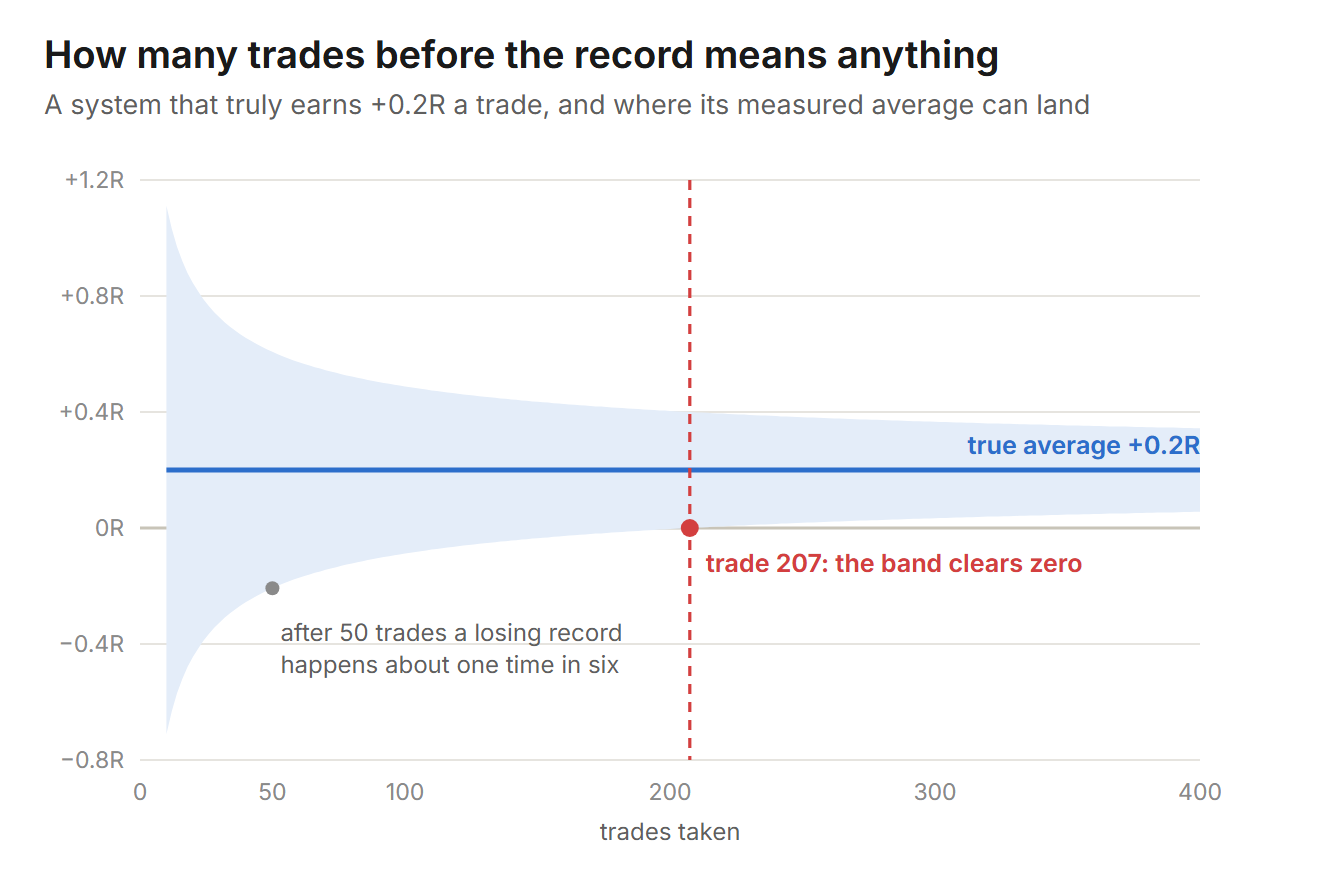
A system with +2R wins, −1R losses and a 40% win rate · the band is ±1.96 standard errors
At one trade a day, 207 trades is about ten months. A system that earns 0.1R a trade needs about 800 trades, more than three years. A trader who abandons a system after a bad month has learned nothing about the system. The opposite mistake costs as much: a rule that stopped matching the market, or a trader who stopped following it, is not fixed by reaching trade 200. Keep reviewing the rules and your execution while the count runs.
Self: the operator#
The self is where good systems go to fail. Dr. Long puts it plainly: without emotional clarity, discipline and self-awareness, "even the best system fails because traders' beliefs override the system signals."
You have seen it, or done it:
- The stop is written down, the price reaches it, and you move it.
- The setup fires, and you skip it because the last two lost.
- A winner reaches its target, and you hold it for more.
- A loss follows, and you size up the next trade to win it back.
Each time the system said one thing and the operator did another.
Dr. Long's answer is the Zero State: a process for resetting emotions before and during each trade "to a state of balance and calm in time and outlook." It releases attachment to the trades before this one, winners and losers alike. It depends on the system: a trade that is already framed tells you in advance where each moment of action will come, so there is nothing left to decide in a panic.
Two practices come with it. Forgiveness and gratitude is how he describes centering yourself after a profit or a loss, so the next trade starts clean. And a rule for when that fails: a trader who loses the Zero State and slips into magical thinking exits the trade immediately.
Where the three meet#
Each pair of domains without the third has a recognizable way of losing money.
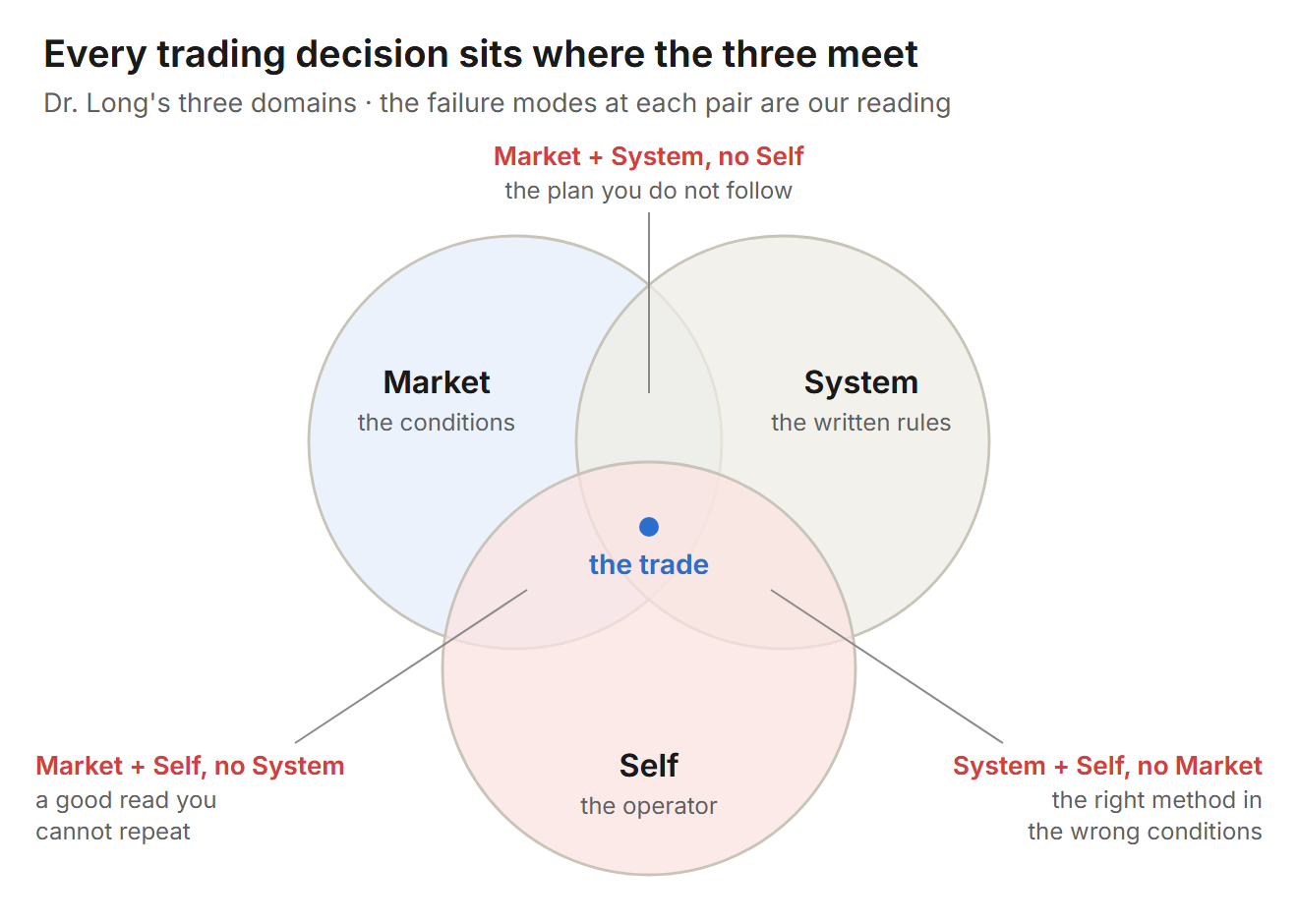
Our reading of the three domains · the failure modes are ours, the domains are Dr. Long's
Market and System without Self is the plan you do not follow. The read was right, the rules were good, and the operator flinched.
System and Self without Market is the right method in the wrong conditions. The trader executes cleanly, on a setup that fires in a market with no critical state behind it, and takes a series of small, disciplined losses.
Market and Self without System is a good read you cannot repeat. The trader sees the move and stays calm, then sizes it by feel and exits by feel, and next month's results bear no relation to this month's.
Mastery is the center. The market offers a critical state, the system has a written rule for it, and the operator carries the rule out without interference. Owl Group Trading describes the end of that road this way: "Mastery comes when these three domains are no longer separate, but fully integrated into one seamless process."
Building the skill#
Repetition alone does not build it. Anders Ericsson and his colleagues put the condition plainly in their 1993 study of expert performance: "In the absence of adequate feedback, efficient learning is impossible and improvement only minimal even for highly motivated subjects."
Their example is a baseball batter. During a three-hour game a batter may see five to fifteen pitches. In the same three hours of practice with a dedicated pitcher, the batter sees several hundred. A trader faces the same arithmetic. A setup that appears once a session gives you about 250 live repetitions a year, and you learn from each one only if you look back at it honestly.
Chess offers the most useful model. In a 2005 study of chess players by Neil Charness and colleagues, the activity that best predicted skill was serious study alone, such as working through master games: hide the next move, choose yours, then compare. Trading has its own version. Work through a past session bar by bar, frame the trade before the next bar appears, then see what happened and what an experienced trader did.
Practice each domain on purpose:
- Market. Before each session, mark where the critical states are in your symbols, if any. Afterward, check whether the moves came from them.
- System. Write every rule down. Frame every trade with the five questions before you take it. Count trades toward the 200 before you judge the result.
- Self. Notice every time you overrode a rule, and write down what you felt when you did it. Dr. Long's Four Part Learning Journal records the moment you noticed something, what you think it means, what you will do about it, and the result.
Keep score in R, and keep score of yourself. A month in which the system lost money and you followed every rule is a good month of practice. A month in which you made money by breaking the rules is a bad one, and the most expensive kind, because it teaches the wrong lesson. Judge each trade as a decision. Over a few weeks, the market rewards some bad decisions and punishes some good ones. Over two hundred trades, it mostly stops doing that.
The market sets the conditions. The system sets the rules. You are the part that has to show up.
On the numbers. The Market, System and Self framing, the definitions of critical state, SSC, RLCO, Z3P, trade framing, the Zero State, forgiveness and gratitude, and the Four Part Learning Journal are Dr. Ken Long's, from his glossary of terms and his Owl Group Trading writing; the quotations are his, except the line on mastery, which is from Owl Group Trading's insights page. The three failure modes in the diagram are our reading. The sample-size figures assume a 40% win rate, +2R wins and −1R losses: 0.2R average and 1.47R standard deviation per trade, so 207 trades for the 95% band (±1.96 standard errors) to clear zero; at a 36.7% win rate, 0.1R a trade, it takes about 800. The figures treat trades as independent and use the normal approximation for the average; they illustrate the scale of evidence needed and are no universal requirement. Real trades vary in size and are not independent, which makes the true numbers larger. The Ericsson quotation is from Ericsson, Krampe and Tesch-Römer, "The role of deliberate practice in the acquisition of expert performance," Psychological Review, 1993, pages 367–368. The chess study is Charness, Tuffiash, Krampe, Reingold and Vasyukova, "The role of deliberate practice in chess expertise," Applied Cognitive Psychology, 2005.