"The market was up today."
Which market? Over the year to October 16, 2026, NVDA and SPY closed in opposite directions on 72 of 251 sessions. On 37 of those, SPY rose and NVDA fell. "The market was up" told an NVDA holder the wrong thing about their own position one day in seven.
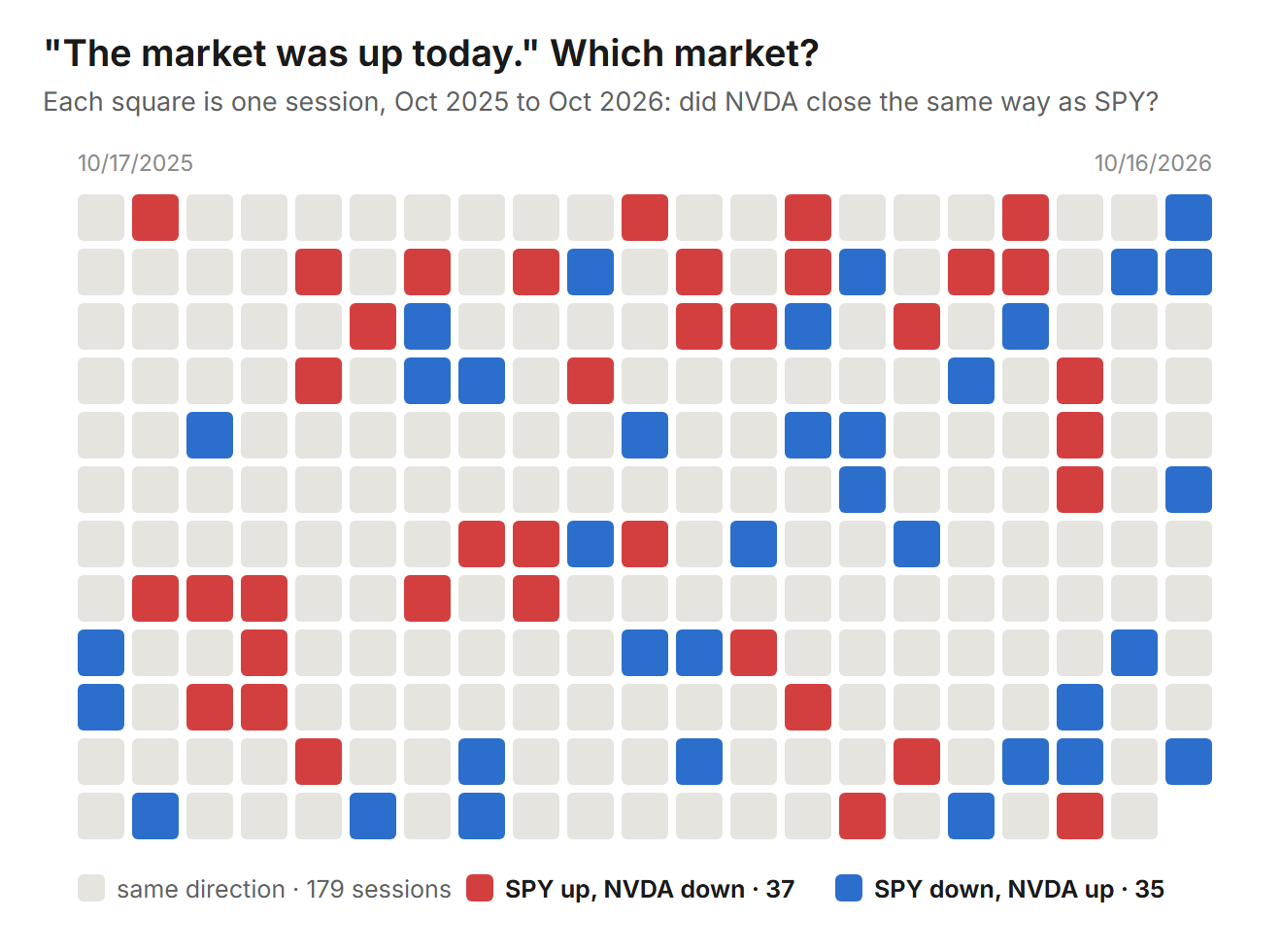
Daily closes · 179 sessions agree, 72 disagree
Ronald Howard, who pioneered decision analysis at Stanford and gave the field its name, put the rule in one line: "Clarity of action depends on clarity of thought. So first you have to get your thinking straight." This essay is about the words a trader thinks with, and how many of them are three words wearing one coat.
The clarity test#
Howard's tool for this is the clarity test. Imagine a clairvoyant who knows everything that has happened and everything that will, and has no judgment at all. A statement is clear if the clairvoyant could say whether it came true without asking you what you meant.
"The market was up today" fails. The clairvoyant asks: which market? "SPY closed above yesterday's close" passes. "The trend is up" fails: on which chart? "NVDA's close is above its 50-day average" passes.
Market, System, Self said that a rule two traders can disagree about is a feeling. The clairvoyant is the second trader, with perfect information and no opinions. Every word in your rules has to get past them.
Why reading never fixes it#
You can read about trading for years and keep every fuzzy word intact, because reading never forces a choice. "Trade with the trend" reads as sound advice whether trend means the last hour or the last year. You nod and move on.
A live trade forces the choice, at the worst moment. The price reaches the level you called "my stop," and you discover you meant three things by it: the price where the trade is wrong, the order sitting at the broker, and the loss you were willing to take. They are the same number only on a quiet day. Leverage Works Both Ways showed what the gap looks like: Cerebras opened 16% below the previous close, and no stop order placed above that open could fill at its price.
The index investor never meets this. The index methodology settles every word in advance: which market, which weighting, which day to rebalance. The trader took the decisions back, in Every Investor Is a Trader, and the definitions came with them.
Where the words fork#
Every fuzzy trading word fails the clarity test for one of three reasons:
- Which thing? What, exactly, is the word pointing at?
- Which timeframe? Over what stretch of time?
- Measured how? What observable fact makes the statement true?
Here are the words a newcomer most often carries unsplit.
| Word | What it can mean |
|---|---|
| Market | SPY or QQQ · your symbol's sector · your symbol's own price action · this session, as against the first hour · the other participants, the opponent |
| Trend | up on the daily chart and down on the five-minute, same stock, same moment. Trend without a timeframe is no statement at all |
| Risk | the dollars lost if the stop is hit (R) · the size of the position · the drawdown on the account · how fast the stock moves · "a risky stock" |
| Stop | the price where the trade is wrong · the order that tries to get you out there · a trailing stop · a time stop |
| Setup, signal, entry | the conditions · the trigger event · the order. Newcomers say "setup" for all three |
| Edge | a statistical advantage over hundreds of trades · "I like this one," an opinion about a single trade |
| Volatility | a day's typical range · the options market's forecast · "it moves a lot" |
| Drawdown | from the deposit · from the peak. The Keel's account was up on the first and three points from the line on the second |
| Leverage | margin · day-trading buying power · position size relative to equity |
| Price | last · bid · ask · close. "It went to $50" is four claims |
| Being right | right about direction · made money · followed the rules |
The last row is the one that costs the most. A trader who scores "right" as "made money" will keep a bad habit that paid once. Howard again: "You can't rate the quality of the decision from the quality of the outcome that follows it."
What a glossary settles, and what it cannot#
Owl Group Trading's Learn page has done the first of the three jobs. It splits the words that newcomers run together: state, condition, rule and signal; setup, entry, exit and re-entry; price, indicator, measure and value. Its entry for condition shows what a clear statement looks like:
"Price is above VWAP" means Market trend is bullish. "RL10 Slope > 0" means System momentum is positive. "Three consecutive losses today" means the trader Self is emotionally compromised.
Each of those passes the clarity test. The page then names four tests a condition must meet: observable, measurable, contextual, relevant. Start there. It is the best public answer to which thing that I know of.
A glossary cannot do the other two jobs, and this one is honest about it. Its definition of price is the open, high, low and close "at a specified time frame," and it never specifies one, because the timeframe belongs to your system. Its own material shows the fork at work. "Price above VWAP" makes the market bullish on an intraday chart. The Market Mosaic calls the market bullish from price's distance to the 200-day average on the daily chart. Both are precise. On the same afternoon they can disagree, and a rule that says "when the market is bullish" has to say which one it means.
So the glossary gives you the categories. Your rules supply the timeframe and the measurement. Until they do, the words in them are still fuzzy, however good the glossary.
Three questions, every word#
Take each word in a rule and ask:
- Which thing? The market, or SPY, or NVDA, or NVDA's sector?
- Which timeframe? The daily chart, the five-minute, the last ten sessions?
- Measured how? Above the 50-day average, or the regression line sloping up, or "it looks strong"?
A word that answers all three passes the test. A word that answers two is still a feeling. "Trend" becomes "NVDA's 10-day regression line on the daily chart is rising." "The market is choppy" becomes "SPY's five-day range is below its 30-day median range." Longer, and the clairvoyant can check it. Your system will pick other measurements. The requirement is that it picks.
Here is the practice. Open your journal and read the last ten entries. Circle every trading word, and for each one ask the three questions. Count the circles, and count how many of them are "the market." Rewrite each circled word until it passes, and the rewritten entries become something you can check next month, which the originals never were.
Then do the same to your rules. A rule with a fuzzy word in it was never a rule. It was permission to decide later, under pressure, with money on the line, which is the one place a trader cannot think clearly.
Say which market, on which chart, measured how. Then the trade can follow.
On the numbers and sources. Prices are daily closes for NVDA and SPY, October 16, 2025 to October 16, 2026, 251 sessions; a session counts as disagreeing when the two closed in opposite directions from the day before. Ronald Howard's words are from Stanford Engineering's profile of him, October 31, 2014. The clarity test and the clairvoyant are from his paper "Decision Analysis: Practice and Promise," Management Science, 1988. The condition examples and the four tests are quoted from Owl Group Trading's Learn page; the Market Mosaic definition is from Dr. Ken Long's glossary. The table of forks is ours.