The arithmetic is simple. Put up $100,000, borrow another $100,000, and buy $200,000 of stock. A 10% rise earns $20,000, a 20% return on your money. A 10% fall costs the same $20,000.
This summer Cerebras (CBRS) rose 55% in ten trading sessions, then fell 51% from its peak by October 16. I replayed three $100,000 accounts through that move on CBRS's one-minute prices. One never borrowed. One borrowed once and held. The third kept borrowing as the stock rose. By October 16 they had $75,000, $50,000 and $24,000 left. What separated them was what each did with its gains.
The accounts are simulated. The lessons drawn from them are not. A fair bit of my own pain and learning went into them.
What you are borrowing#
Two numbers describe the account at every moment. Equity is your money: what the stock is worth, minus what you owe. The loan is the broker's money, and it stays the same size whatever the price does. Every dollar the stock gains or loses lands on your equity.
The broker also sets a floor. When your equity falls below a set share of the stock you hold, the broker sells your shares without asking. That is the margin call. US rules set a minimum floor of 25% for an ordinary margin account, and brokers can require more, especially on volatile stocks. They can raise it without notice and sell under their own policies, sometimes before you have a chance to respond. After an overnight gap, the first price they can sell at may be far below the previous close.
How leverage builds an account#
CBRS closed at $169.39 on July 29 and at $262.06 on August 12. Three $100,000 accounts bought at the July 29 close.
| Account | Stock held on Aug 12 | Equity on Aug 12 | Gain |
|---|---|---|---|
| No margin | $155,000 | $155,000 | +55% |
| 2× margin, holds | $310,000 | $210,000 | +110% |
| 2× margin, borrows more as it rises | $458,000 | $229,000 | +129% |
This is the case for leverage. A trader with a real edge who never borrows earns that edge on their own capital. At twice equity, the same edge compounds on twice the capital. Leverage also magnifies a misjudged edge and every drawdown, and it can force you out before the edge has time to work.
The trap: borrowing more as it rises#
The third account did what traders do in a strong move. At every close that ended higher, it borrowed against the day's gain and bought more stock, back up to twice its equity. Its loan grew from $100,000 to $229,000, and the new money bought CBRS at the highest prices of the move. When many traders add borrowed money to the same rising stock, their buying can amplify the rally and leaves more positions exposed when it turns.
One detail decides who survives what comes next. The account that held kept its loan at $100,000 while its equity grew, so its leverage fell from 2.00× to 1.48× without any action. The account that kept borrowing stayed at a full 2.00× all the way to the top.
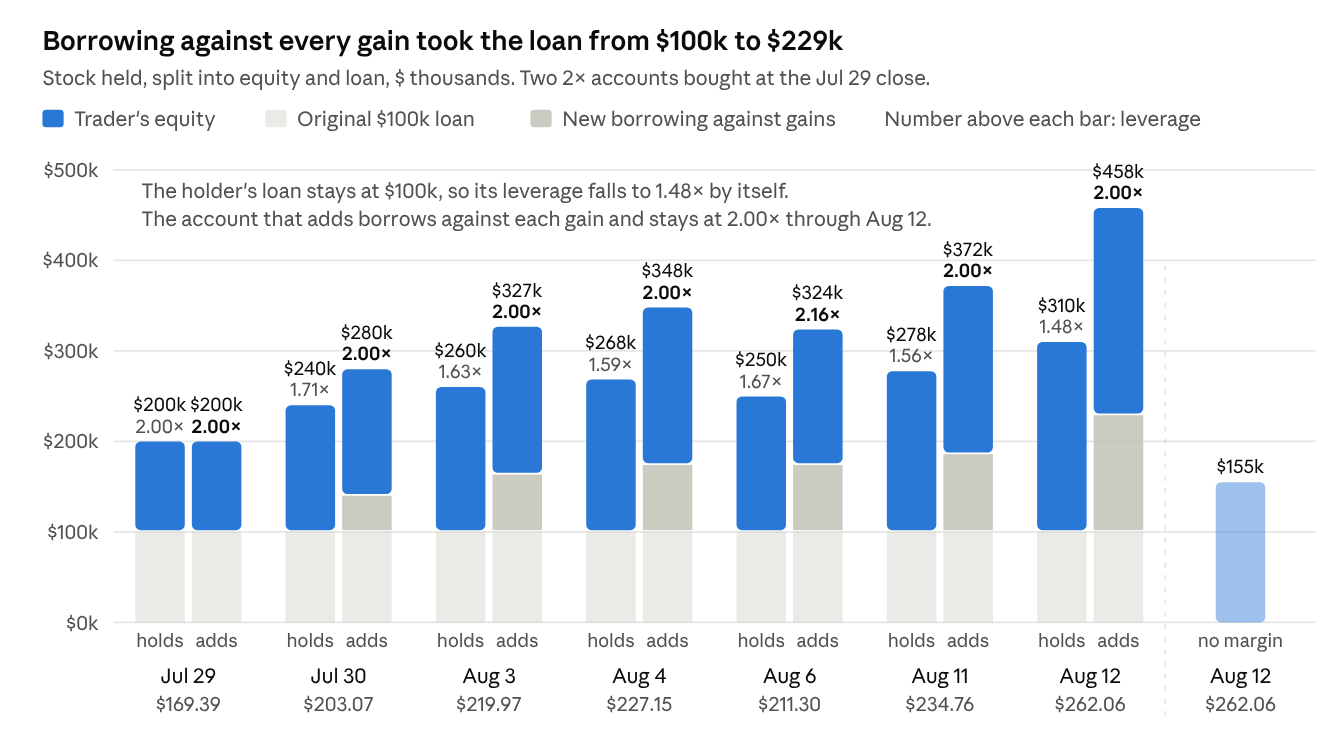
CBRS one-minute prices replayed, Jul 29 to Aug 12, 2026 · official closes
How the same leverage ends an account#
On August 13, CBRS opened at $220, 16% below the previous close. On October 16 it closed at $127.21.
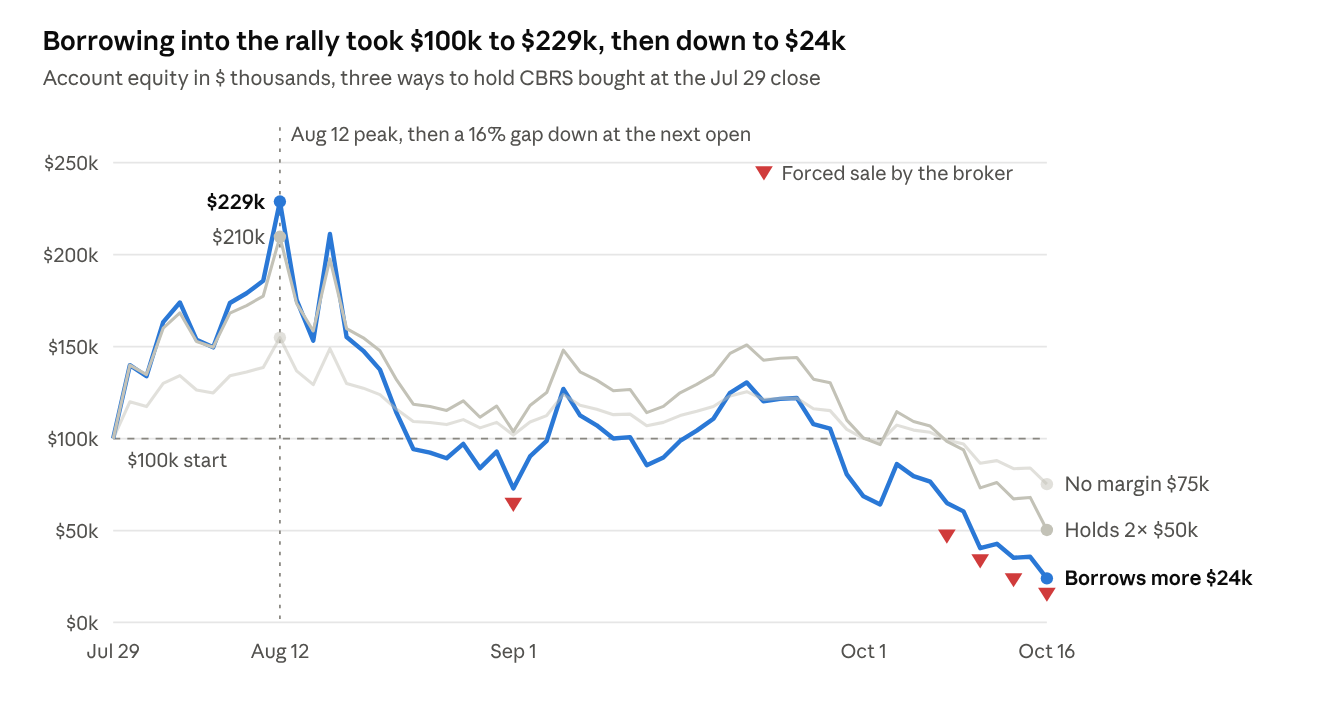
CBRS one-minute prices replayed, Jul 29 to Oct 16, 2026 · 2× Reg T, 25% maintenance
The account that borrowed into the rally held $458,000 of stock at the August 12 close. The next morning's open took $74,000 of its equity. Its equity was still 40% of the stock, above the 25% floor, so nothing was sold that day. The slide did the rest. Each forced sale repaid part of the loan at a lower price, so when CBRS bounced between sales, those shares were already gone:
| When | CBRS | Stock value | Loan | Equity |
|---|---|---|---|---|
| Aug 12 close, the peak | $262 | $458,000 | $229,000 | $229,000 |
| Aug 13 open, the gap | $220 | $384,000 | $229,000 | $155,000 |
| Oct 16, after the fifth forced sale | $131 | $89,000 | $62,000 | $27,000 |
| Oct 16 close | $127 | $86,000 | $62,000 | $24,000 |
Between the second and third rows, the broker sold $167,000 of stock in five sales, at $174, $162, $151, $141 and $131, each time equity dipped below 25% of the stock. The account ended 90% below its peak.
The account that held never received a margin call. Its leverage had drifted down to 1.48×, which put its floor below every price CBRS printed. It still ended at $50,000, half the starting money.
A fourth account shows what full leverage does to a buyer who arrives at the top. On August 17 it bought CBRS at $250.82 with four times its equity, the most a pattern day trader (an account holding at least $25,000) may buy during the day, where the broker allows it. By the close it had to cut back to 2×. It was sold out four times in October and ended at $12,201. The stock fell 49% from that entry. The account fell 88%. Held at 2× with no sales, the same fall would have left about $1,000. The forced sales are why anything remains.
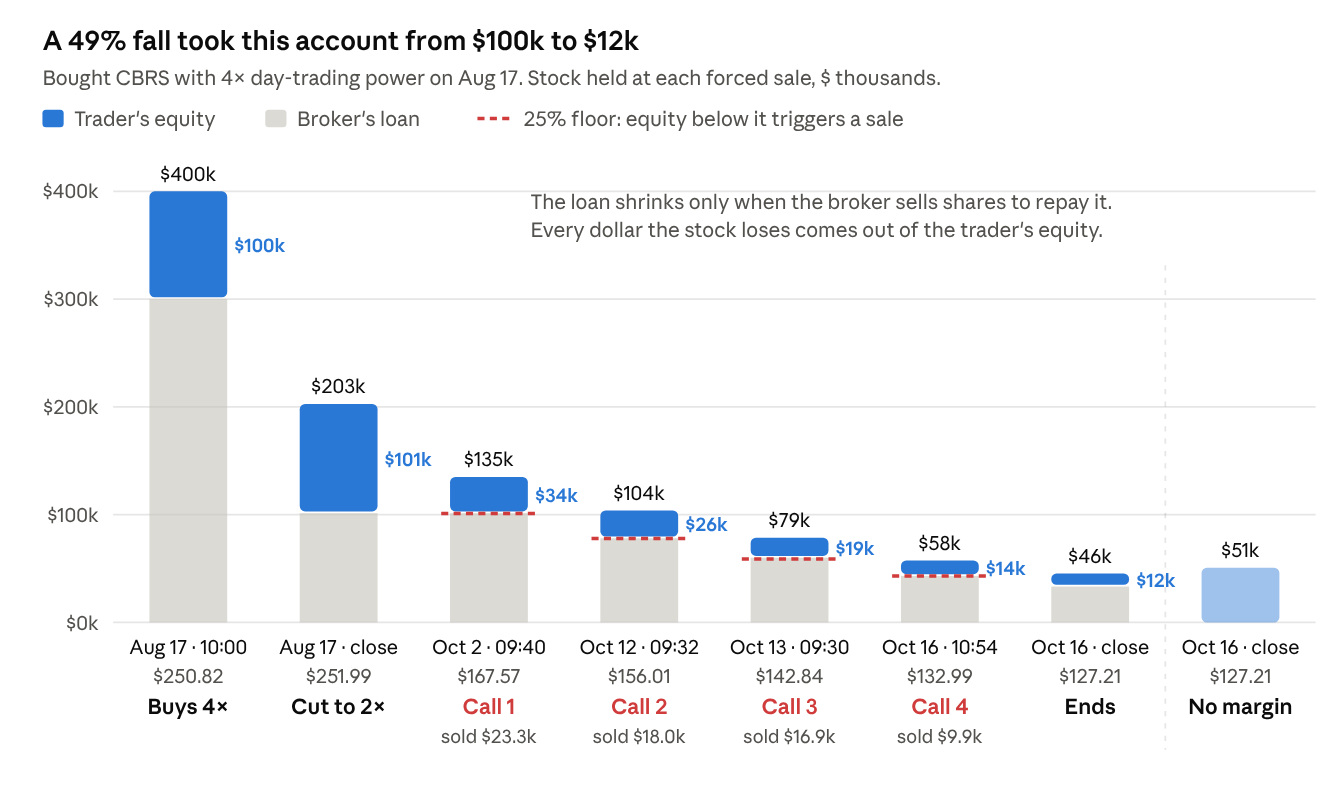
CBRS one-minute prices replayed, Aug 17 to Oct 16, 2026 · 4× intraday, 2× overnight, 25% floor
The arithmetic behind all of it:
| Leverage | Fall to the first margin call (25% floor) | Fall that wipes out the equity |
|---|---|---|
| 1× | never | 100% |
| 2× | 33% | 50% |
| 4× | any fall at all | 25% |
CBRS fell 51% from its August peak. A 2× position bought at the peak and left alone would have lost more than all of its money. Margin calls are what stop that, by selling you out on the way down. Full leverage on a stock that can open 16% lower is a bet that the gap never comes.
The climb back#
A loss is harder to undo than it looks. Halve an account and it needs to double to get back. Lose 88% and it needs to grow more than eightfold:
| Account | Peak equity | Equity Oct 16 | Down from peak | Gain needed to get back to $100,000 |
|---|---|---|---|---|
| No margin, bought Jul 29 | $155,000 | $75,000 | 52% | +33% |
| 2×, held, bought Jul 29 | $210,000 | $50,000 | 76% | +100% |
| 2×, borrowed more as it rose | $229,000 | $24,000 | 90% | +317% |
| 4× day-trading power, bought Aug 17 | $101,400 | $12,201 | 88% | +720% |
The forced sales also left the 4× account with fewer shares. For it to get back to $100,000 by holding, CBRS would have to climb to about $373. A cash buyer who entered on August 17 at $250.82 needs the stock back at about $251.
Why hot stocks fall so hard#
When many accounts hold the same stock on margin, their margin calls arrive together and feed each other. A falling price pushes a group of accounts below their floors. Brokers sell those shares at the market. The selling pushes the price lower, which pushes the next group below their floors.
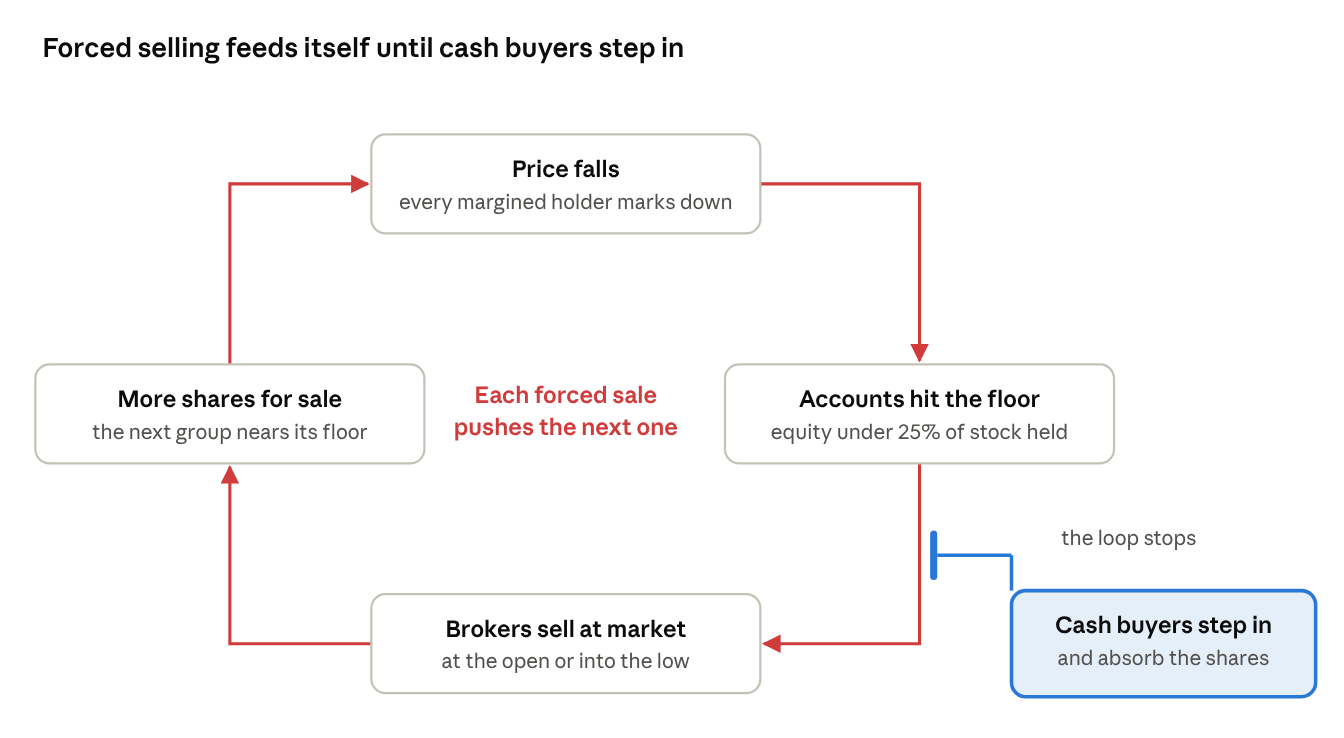
The forced-selling loop · 4 steps and the buyers who stop it
The largest recorded case is Archegos Capital in March 2021. A family office held concentrated positions through swaps at several banks, at several times its capital. When ViacomCBS fell, Archegos could not meet the margin calls, and the banks sold the positions in large blocks. ViacomCBS lost about half its value in a week. The banks lost more than $10 billion between them, $5.5 billion of it at Credit Suisse.
The summer's AI-infrastructure names moved the way a crowded, leveraged trade moves:
| Stock | Jul 29 to peak | Peak to Oct 16 |
|---|---|---|
| CBRS (Cerebras) | +55% | −51% |
| CRWV (CoreWeave) | +77% | −43% |
| NBIS (Nebius) | +85% | −40% |
| QQQ, Jul 29 to Oct 16 | +7% |
All three peaked within three sessions of each other, between August 12 and August 17. CBRS traded 4.9 million shares a day on the way up and about 10.5 million a day in each of its two falls.
The selling eased in between. From August 27 to September 25, volume dropped back to 5.6 million a day and the stock rose 14%. Then the second fall began. On October 16 CBRS closed at $127.21, its lowest close since it listed on May 14.
What the data show is a pattern: a fast rise on ordinary volume, two falls on about double that volume, and a pause when volume dropped back. What they cannot show is who was selling. Brokers do not publish which accounts they sold out. Forced selling fits the pattern and the mechanics above; the data cannot confirm it. Archegos shows how such selling works when it happens. It says nothing about who sold CBRS.
The story and the price#
The case for the company was still being made near the bottom. On October 5, with CBRS at $166.43, UBS analyst Timothy Arcuri kept a Buy rating and a $330 target, crediting Cerebras's wafer-scale chip with "up to 6x the inference performance of GPU clusters." OpenAI had signed a multi-year deal for 750 megawatts of Cerebras compute, valued at more than $20 billion. Nine sessions later CBRS closed at $127.21.
The analyst may yet be right about the business. That does nothing for an account the broker sold out at $131. As Foundations of Investing puts it, trading earns from being right about price over horizons short enough that business performance has not yet shown up. Investing has a tailwind. Trading has a cost base and an opponent. On margin, the broker's floor also decides how long you are allowed to be wrong.
Elite traders settle that conflict by following the price. Dr. Ken Long calls the working condition the Zero State: calm, alert readiness with no stake in where the price ought to go. From there a trader acts on what the price is doing. A falling stock with a strong story is still a falling stock. Dr. Long's rule for the moment a trader loses that state and starts arguing with the price is short: get out.
Rules for borrowing#
Leverage multiplies whatever your trading already is. Build the skill first, then borrow.
- Prove the edge before borrowing. Trade without margin for at least a year. Log every trade after costs and compare the result with simply holding an index fund, as Foundations of Investing describes. If you cannot beat the index with your own money, borrowing multiplies the shortfall.
- Size for gaps. A stop order cannot fill inside an overnight gap. Find the largest gap the stock made in the past year and work out what it does to your account at your leverage. CBRS opened 16% lower on August 13. At 4× that is 64% of the account in a single print.
- Let a fixed loan shrink your leverage. A rising position builds a cushion by itself. Borrowing against every gain spends the cushion at the highest prices.
- Treat day-trading buying power as day-trading risk. Know what you will hold overnight before you buy. Held overnight at 4×, a 25% fall ends the account, and hot stocks gap that far.
- Count related stocks as one position. CBRS, CoreWeave and Nebius rose together and fell together. Three margined positions in one theme are one bet carrying three loans.
- Set your exit before the broker does. The margin floor is the broker's limit. Decide your own maximum loss before you enter. Wiring in cash to defend a losing leveraged position moves that limit after the fact.
Leverage changes who controls the exit. With a fixed loan, a rising stock makes the account safer. Borrowing against every gain spends that safety just as the stock is most expensive. When the turn comes, the broker decides what gets sold and at what price, and an account that has been sold out cannot wait for the recovery.
There is a fair objection. A truly skilled trader uses leverage in both directions: long on the way up, short on the way down. Take the account that borrowed all the way up and suppose it flipped to a 2× short at the August 12 close. By October 16 it would have held about $465,000, before borrowing fees, from the same $100,000. CBRS never traded above $261.08 after that close, so the short never faced a margin call.
That is the prize, and it is why skilled traders borrow. Winning it took calling the top on the day it happened, then holding the short through a 14% rebound in September without flinching. Few traders can do that once, and fewer can do it again. Really good traders are rare. Most traders who borrow are the other accounts in this article.
Cut leverage when it feels least necessary.
On the numbers. Each account was replayed on CBRS one-minute prices from July 29 to October 16, 2026. The account that kept borrowing bought more at every higher close from July 30 to August 12, back to 2×. Margin follows US Regulation T: 2× overnight, 4× intraday for pattern day traders, a 25% maintenance floor. When equity breaks the floor, the model sells back to 30% at the trigger price, or at the open after a gap, less 0.25% slippage. Margin interest and commissions are left out, and both would make every leveraged result worse. Individual brokers set their own floors, often above 25% on volatile stocks, which brings the calls sooner. Volume figures are daily CBRS volume from the same data. The Archegos figures are from public reporting at the time.