"It's not a loss until I sell."
Everyone who has traded has said it, or heard it in their own head. It is true in exactly one sense, the tax return's. The account is already worth less; selling changes nothing about that except whether it can get worse. It is also the first of five sentences that arrive after a large loss, in roughly the order a famous list predicts: denial, anger, bargaining, depression, acceptance. The list is on posters in hospital corridors and in half the self-help books ever written. It is also less true than the posters claim, and that is where this essay starts, because the ways the list fails for grief are exactly the ways it holds for a trading account.
Where the list came from#
Elisabeth Kübler-Ross published the five stages in On Death and Dying in 1969. Her subjects were not the bereaved. They were terminally ill patients at a Chicago hospital, and the stages described how they met their own deaths. The extension to grief after a loss came later, in On Grief and Grieving in 2005, written with David Kessler.
Kübler-Ross never claimed the sequence the posters show. In 1974 she wrote: "Most of my patients have exhibited two or three stages simultaneously and these do not always occur in the same order."
The one large test of the model as a sequence came in 2007. Paul Maciejewski and colleagues followed 233 bereaved people in Connecticut and measured five states at points from one month to two years after the loss: disbelief, yearning, anger, depression and acceptance. Once each curve was rescaled, the peaks did fall in the predicted order, disbelief first and depression around the sixth month. But in the raw responses acceptance was the most strongly endorsed of the five at every point they measured, from the first month on. Most people accepted the loss early and grieved alongside the acceptance. The negative states were all in decline by six months.
So for grief the list is a vocabulary, not a schedule. People hold several states at once, acceptance arrives early for most, and nobody has to pass through anything.
Nobody is comparing a margin call to a death. The comparison is about the sentences, and the sentences are the same.
The same five sentences, with prices#
A trading loss differs from grief in one way that matters. In grief the stages are feelings, and a feeling costs nothing to hold. In an account each stage is a decision, the decision has a date, and the date has a price. You can look up what each one cost.
Leverage Works Both Ways replayed a $100,000 account that borrowed more as Cerebras rose, on one-minute prices. It peaked at $229,000 at the August 12 close. The next morning CBRS opened 16% lower. Here is the rest of that account's life, read as the five stages. The equity is the replay. The stage labels are ours.
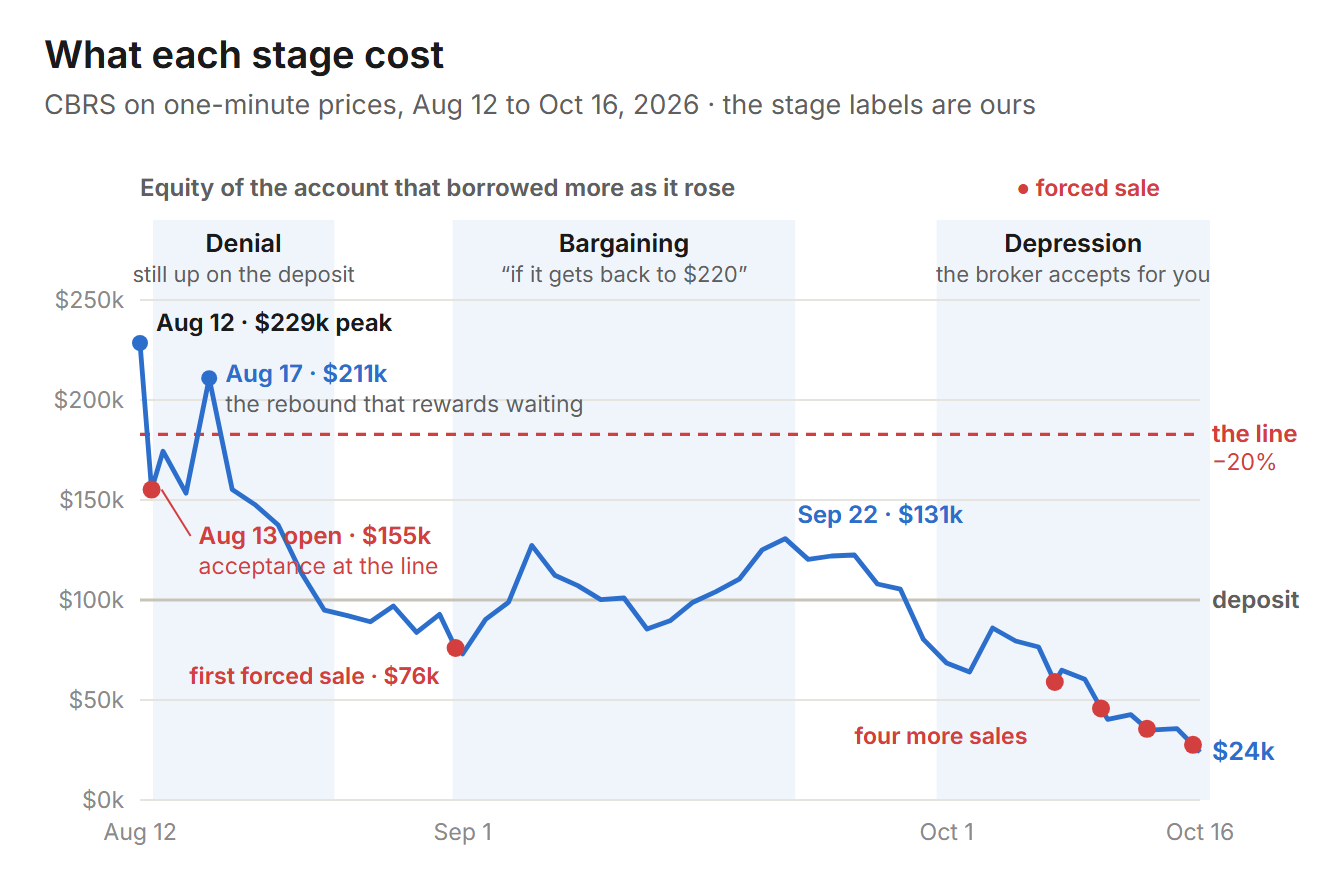
CBRS on one-minute prices, Aug 12 to Oct 16, 2026 · the stage labels are ours
Denial: "It's not a loss until I sell"#
At the August 13 open the account was worth $155,000, 32% below its peak. It was also 55% above the money that went in. Both are true, and the trader in denial chooses the second one. Which Market? listed drawdown among the words that fork: from the deposit, or from the peak. Denial is choosing the deposit.
Denial is also rewarded, which is why it lasts. Two sessions later, on August 17, CBRS closed within 4% of its peak and the account was worth $211,000. For a trader who had held, that day was proof. It was the last close above the peak's 20% line the account would ever see. By August 24 the equity was $95,000, below the deposit for the first time, and the only thing the trader had done was nothing.
In Maciejewski's study the first state to peak was disbelief, at month one. In an account the first month is where the loss is still small enough to take.
Anger: "I'll make it back"#
The replay has no anger in it, because a model does not size up. Traders do. The next trade goes on at twice the size, to win back what the last one took. Dr. Ken Long lists revenge among his Eight Imbalances, the paired states that break traders; its pair is rigidity. The Keel has the arithmetic: at a 1% risk unit the 20% line is 22 losses away, at 2% it is 11. Doubling the size to recover halves the distance to the line.
Bargaining: "If it gets back to $220, I'll get out"#
On September 1 CBRS fell below $175 and the broker made the first forced sale, at $174. The account was worth $76,000. Then the stock rallied 23% in three weeks, to $212 on September 22, and the bargain seemed to be working. It was not. The broker had sold a sixth of the shares at the low, so the account caught the rebound with fewer of them and reached only $131,000. CBRS never printed $220 again.
A bargain is a stop you set above the price, and it has the shape of all bargains: it names a number the market has not agreed to. The price that would make the trader feel better has nothing to do with the price where the trade is wrong.
Depression: "I'm done"#
In October the account stopped making decisions and the broker made them instead: four more forced sales, at $162, $151, $141 and $131. On October 16 it was worth $24,000. The Edge S2 Guide's entry on drawdown puts the general case in five words: drawdowns are where traders quit. Quitting and accepting are not the same thing. The trader who quits here never accepts the loss. The broker accepts it for them, five times, at the worst prices on the chart, and the trader's only part in the decision was to be absent from it.
Acceptance: "The loss is real, and it is mine"#
In grief, acceptance is the state most people are already in. In an account, acceptance is the one stage with a price that can be fixed in advance.
The account had a line available to it: 20% below its peak, the rule The Keel argues for, which puts it at $183,000. The August 13 open was through that line in one print, and selling at the open would have left $155,000 in cash, up 55% on the year, with nothing to recover.
| Accept on | Equity left | To get back to $100,000 |
|---|---|---|
| Aug 13, the open, at the line | $155,000 | nothing to recover |
| Aug 17, the rebound close | $211,000 | nothing to recover |
| Aug 24, below the deposit | $95,000 | +5% |
| Sep 1, after the first forced sale | $76,000 | +32% |
| Sep 22, the second rebound | $131,000 | nothing to recover |
| Oct 1 | $69,000 | +46% |
| Oct 16, after the fifth forced sale | $24,000 | +317% |
Read the table honestly. Waiting paid twice, on August 17 and on September 22, and anyone who argues for the line has to say so. That is the whole reason denial and bargaining are sticky: they are sometimes right. The line is not a forecast that the price will keep falling. It is a decision, taken at the dock, that a 32% fall from the peak on borrowed money is a sign the trade is wrong, and that the two rebounds do not get a vote. Acceptance is the decision to stop renegotiating with the market.
Why acceptance is cheap on the day and dear later#
The cost of a late acceptance is not only the dollars. The Edge S2 Guide works the arithmetic of a refused stop. Long at 100 with a stop at 99, you take the loss and you are flat, down 1R. A fall of $2 from the entry, caught short, makes you whole. Refuse the stop, ride to 97, and the short that makes you whole needs the price at 94: a $6 fall from the entry, three times the move, and far rarer. The refused loss has not only grown. It has made the trade that would repair it less likely to come.
Three other things are held while you wait, and the Guide names them: capital, which is pinned to the position; attention, which is on the loss and off the next setup; and conviction, which is spent defending a thesis instead of reading the chart. The CBRS account held all three hostage for 46 sessions.
Dr. Long calls a loss tuition, not failure. The tuition is the 1R. Everything after it is a late fee.
Putting acceptance on the schedule#
Grief cannot be scheduled, and the research says it does not need to be. A trading loss can, and the structures are the ones this series keeps returning to, because every one of them moves acceptance from a feeling to a date.
- The resting stop, placed when the trade is framed. It is acceptance of the 1R loss, signed before the loss exists.
- The drawdown line, 20% from the peak, chosen before the first trade and checked at every close. It is acceptance of the losing spell, signed before the spell.
- Size for the gap, so the line survives an open like August 13 with the account intact.
- The journal, in R. A loss recorded as −1R and graded against the rule is accepted. A loss recorded as "CBRS, ugh" is not.
And for the loss that got through anyway, Dr. Long's practice has a name. Forgiveness and gratitude is, in his glossary, "a technique to center oneself either in the daily preparation process or after a profit or a loss to regain the zero state in preparation for the next trade." It is the acceptance stage, done on purpose, in the time between one trade and the next, so that the next trade starts from zero and not from the hole.
That is the difference the research points to. For the bereaved, acceptance comes first for most and on its own time for the rest. For a trader, it comes when the rule says, or when the broker says. One of those is $155,000. The other is $24,000.
Accept the loss at the line, on the day. Letting the broker accept it costs more.
On the numbers and sources. The account is the "borrows more as it rises" account from Leverage Works Both Ways, replayed on CBRS one-minute prices from July 29 to October 16, 2026 under the same rules (2× Regulation T, 25% maintenance floor, forced sales back to 30% at the trigger price less 0.25% slippage, no interest or commissions). Equity figures are closes except where an open or a forced sale is named; the rebound figures are closes, September 1 to September 22. The 20% line is 20% below the $228,507 peak. The stage labels on the chart and in the table are our reading of the replay, which has no emotions in it. The refused-stop arithmetic is ours, after the worked example in the Edge S2 Guide. Kübler-Ross, On Death and Dying (1969); Questions and Answers on Death and Dying (1974), pages 25–26, for the quotation; Kübler-Ross and Kessler, On Grief and Grieving (2005). Maciejewski, Zhang, Block and Prigerson, "An Empirical Examination of the Stage Theory of Grief," JAMA 297(7), 2007, 716–723: 233 bereaved people, 1 to 24 months after the loss; the ordered peaks come from the rescaled curves, the dominance of acceptance from the raw responses. The Eight Imbalances and Forgiveness and gratitude are Dr. Ken Long's, from his glossary; "tuition, not failure" is his phrase.